Know who authorized every system you run.
Prove it when asked.

The authorization layer for automated systems

The signed record of who accepted the risk, what the system may do, and until when.

The agent removed 40,000 posts.
Who said it could?

A search through Slack, email, and Jira should not be the only way to find out.

In licet, inspect the permitted actions, exclusions, conditions, and named risk acceptor together. The example below shows how that decision is recorded.

Authorization recordAMB-2026-0007 · authorization v1

Community Standards enforcement agent

Meridian · content moderation agent

Institutional authorization
Authorized
Validity
⊙ Valid
Risk accepted by
Priya Raghunathan
Expires
Issued
Operational assuranceIndependent evaluation · sample attachment
Illustrative attachment · fictional sample

Independent evaluation — example attachment

This sample demonstrates where an evaluation attachment would appear in the record. No evaluation was performed for this illustration. It contains no evaluator, findings, test results, or assurance opinion and is not part of the signed public demonstration record.
System boundaryProposal v1 · 5 tools · 3 exclusions
Declared tools
content_removal, visibility_reduction, notice_intake, appeal_disposition, age_estimation
Explicitly excluded
account_termination, private_messages, ad_delivery
Environments
prod-eu, prod-uk, prod-global
Data domains
user_content: public_posts_and_comments; minor_accounts: age_flagged_accounts_only; behavioral_signals: enforcement_features_only
Conditions 23
Act only on published policy grounds
Risk acceptance
Priya Raghunathan
Illustrative demo state · AMB-2026-0007 · 23 conditions · Fictional institution and reviewers · Evaluation attachment is a sample. The separately linked signed demonstration is MER-2026-0001, with 13 conditions.

How your team uses licet

From proposed scope to a decision you can produce.

  1. Define scope

    Describe the system, permitted actions, environments, and explicit exclusions.

  2. Review and accept risk

    Connect conditions to sources and interpretations. Gather concurrences and name the person accepting residual risk.

  3. Issue a signed record

    Preserve the approved version, its conditions, and its expiry. Export the record for independent verification.

  4. Review changes and renew

    Use the Registry to identify approaching expiry and records needing attention. Revisit authorization when scope, policy, or authorities change.

The working prototype supports this record lifecycle. Production integration and operational assessment are separate work.

A shared decision.
Useful to every reviewer.

For platform teams

Make the boundaries of automation explicit. See what has been authorized, which conditions apply, and where permission ends.

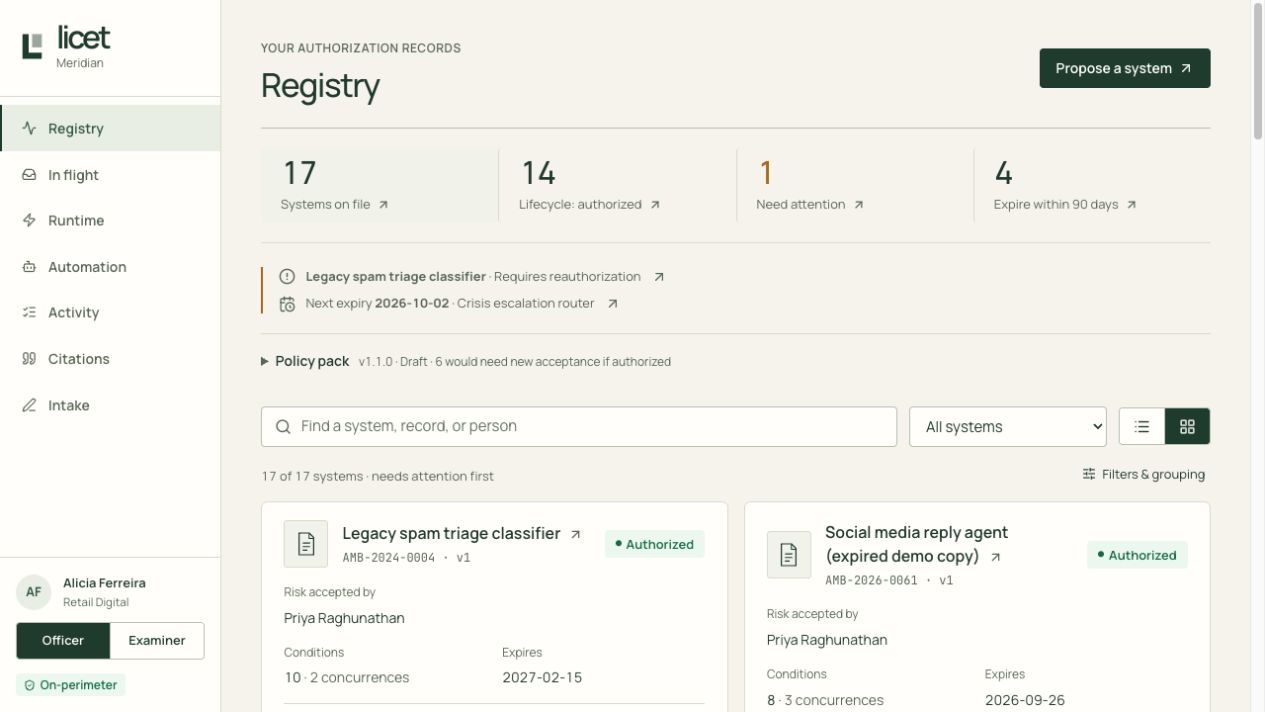
Actual licet Registry showing demonstration system records and authorization status.

For legal & policy teams

Keep institutional decisions connected to their sources, interpretations, and owners. Produce the record when someone asks.

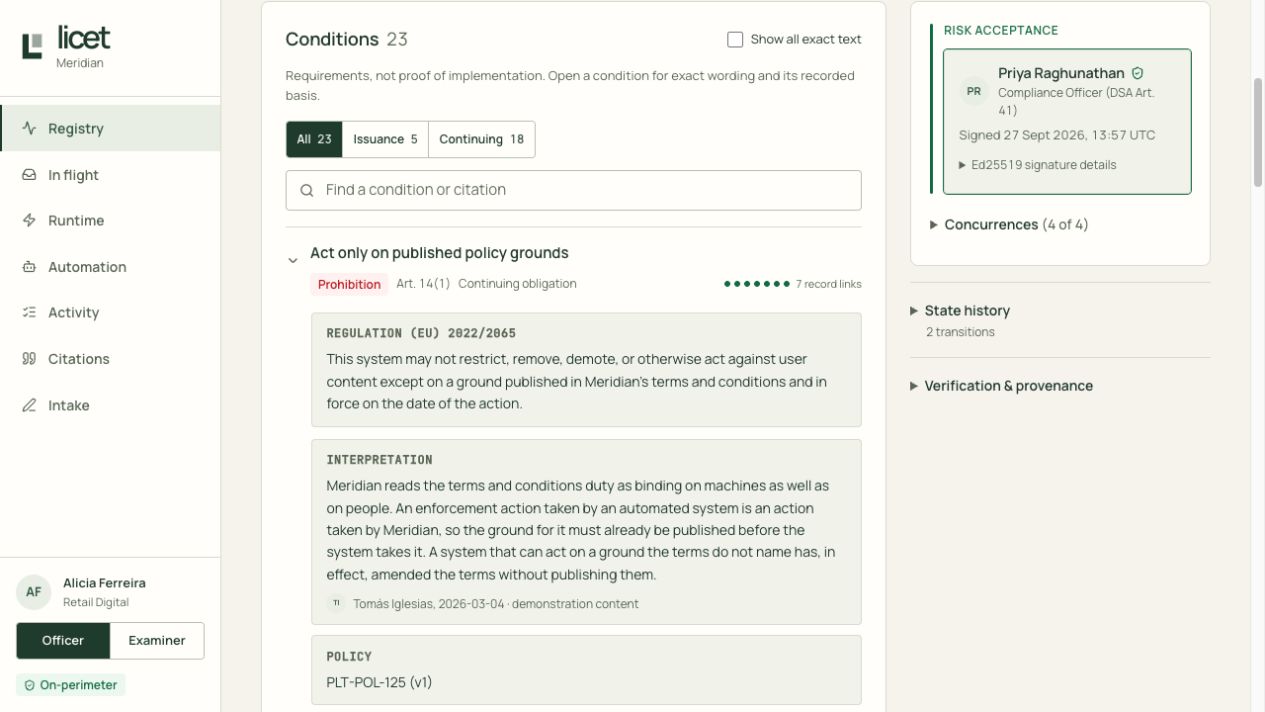
Actual licet condition showing a source, attributed interpretation and policy reference.

Explore the tools behind the workflow.

Bring scope, conditions, exclusions, and the named risk acceptor together in a signed, versioned record.

Inspect a signed demonstration record ↗

Optional runtime enforcement. Check proposed actions against the recorded authorization before they proceed. Production executor integration is required.

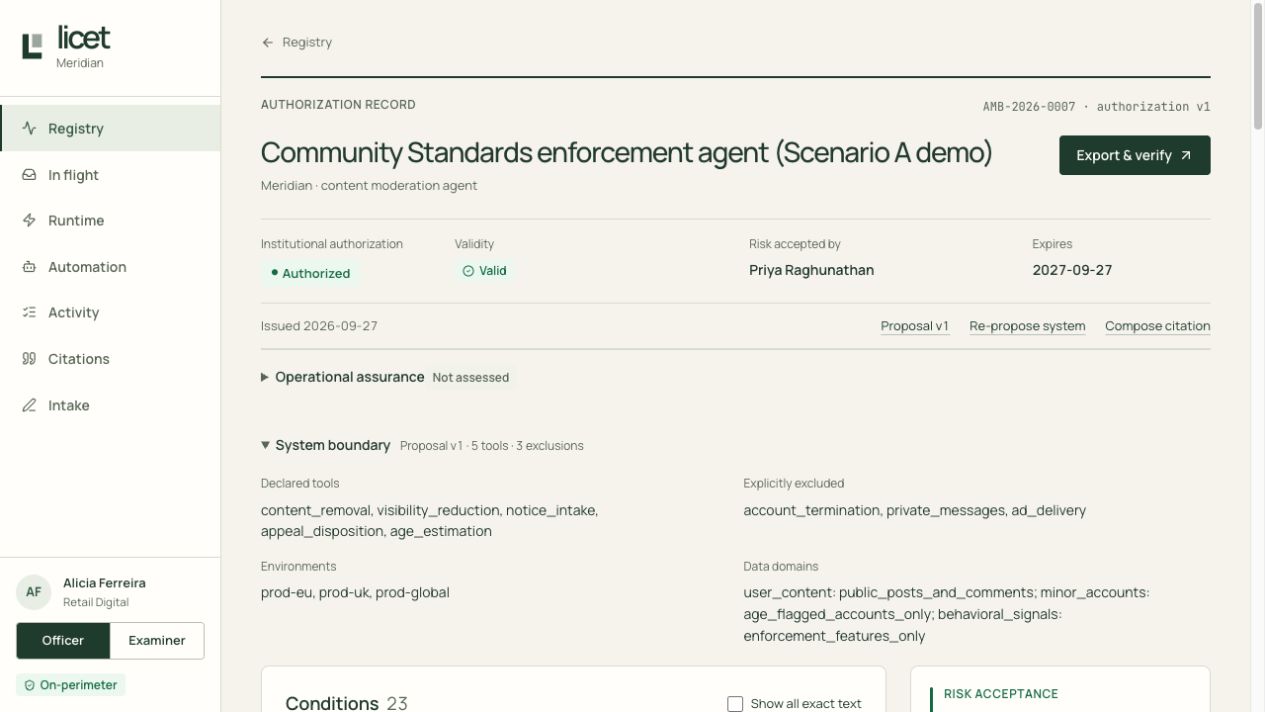
The actual licet authorization record with its system boundary expanded.
Open full-size authorization record screenshot ↗
The scope and exclusions remain attached to the institutional decision.

Built by the people who had to sign off.

About licet ↗
David Gleaton, co-founder of licet.

David Gleaton

Co-Founder

Twenty years across seven federal agencies, where no system goes live until a named official accepts its risk in writing. licet brings that discipline to every automated system. American Service Fellow in the Mid-Career MPA program at Harvard Kennedy School. MA in Strategic Studies, Air War College.

David’s story at Harvard Kennedy School ↗
Dimitri Morarcaliev, co-founder of licet.

Dimitri Morarcaliev

Co-founder

Swiss lawyer and former compliance lead for a Swiss cantonal government. MC/MPA candidate at Harvard Kennedy School, selected as Switzerland’s representative on a Harvard sovereign AI project.

Patent pending
The record is the product

Evidence you
can inspect.

Preserve the institution’s decision in a form that product, policy, legal, and independent reviewers can examine.

Read the signed demonstration record ↗

An authorization record documents institutional permission.

Named approvals

Keep the risk acceptance and concurrences attached to the version that was approved.

Conditions with context

Preserve the sources, interpretations, limits, and evidence requirements behind the decision.

Independent record verification

Checking signatures…
MER-2026-0001 · Ed25519
Risk acceptance key · SHA-256
Checking public key…
All four approval keys
Demo keys · Embedded MER-2026-0001 record · Signature integrity
Demo snapshot & limits
Signed record
MER-2026-0001
Contents
13 recorded conditions · 4 demo approvals
Fictional risk acceptor
Priya Raghunathan · Compliance Officer (DSA Art. 41)
Recorded expiry
14 MAR 2027

Demonstration signatures establish no real-world identity or approval. Operational assurance is not assessed; legal compliance is not determined. This is a fixed snapshot, not a current authorization check.

Start with one consequential workflow.

Become a design partner

Now selecting design partners.

For teams running a consequential automated workflow, with a workflow owner, an engineering counterpart, and policy or risk reviewers ready to participate.

Together, we define one bounded workflow, exercise it with synthetic or approved de-identified cases, and assess whether a limited integration is justified. You receive a versioned authorization record, decision rationale, evidence-gap report, and proposed integration and measurement plans.

After you submit, licet reviews your introduction and responds to discuss fit. Scope, timing, responsibilities, and commercial terms are agreed before work begins.

BECOME A DESIGN PARTNER

Start with one system.

Tell us what you run and the question you need to answer. We will review your introduction and respond to discuss fit. Scope and terms are agreed before work begins.

Only pressing Submit sends your details. We save your introduction and use it to respond; unfinished entries are not collected. Please keep it nonconfidential. Privacy